
A Network for Aitoloakarnania
The creation of a railway connection between Agrinio, Aitoliko, and Messolonghi met a vital need in the region: linking the inland areas to the sea and transporting agricultural and other products from the fertile plains of the Achelous and Evinos rivers.
Equally important was the connection to Patras and, through it, to the rest of Greece. The mountainous terrain of Varasova and Klokotos, combined with the need for a sea crossing between Antirrio and Rio, made a connection via this route difficult with the means available at the time.
At the same time, there was the prospect of extending the line toward Arta and, provided Ioannina became part of the Greek state, even further north. This would allow for the creation of a western railway axis running from south to north.
The name “Railways of Northwestern Greece” reflected the geography of the Greek state at that time: until 1913, the border in the Arta region ran along the Arachthos River.
Charilaos Trikoupis’s Initiative
The network was part of Charilaos Trikoupis’s plan to develop the country’s railway infrastructure. Its construction was carried out on behalf of the Greek government, at a time when private investors were wary of new railroad projects, as the returns from the networks in Thessaly and the Peloponnese had not met their expectations.
The first contract was signed in 1887 between the Greek government and two Belgian businessmen. It provided for the construction, on behalf of the state, of a metric-gauge line—with a distance of one meter between the rails—that would connect Agrinio with Messolonghi.
Two years later, this section was completed. Trikoupis, however, sought to extend it to Kryoneri, near the mouth of the Evinos River. There, passengers would transfer from the train to a ship, and goods would be transshipped to continue their journey to Patras, and vice versa.
The Belgian businessmen refused to undertake the extension under the proposed terms. Trikoupis then revoked their right to operate the state-owned Agrinio–Messolonghi line.
In 1890, the construction of the Messolonghi–Kryoneri section and the operation of the existing line were granted to the businessman H. Apostolidis. That same year, the “Northwestern Greece Railway Company” (SBDE) was founded, and it took over the operation of the network. The extension to Kryoneri was completed in 1891.
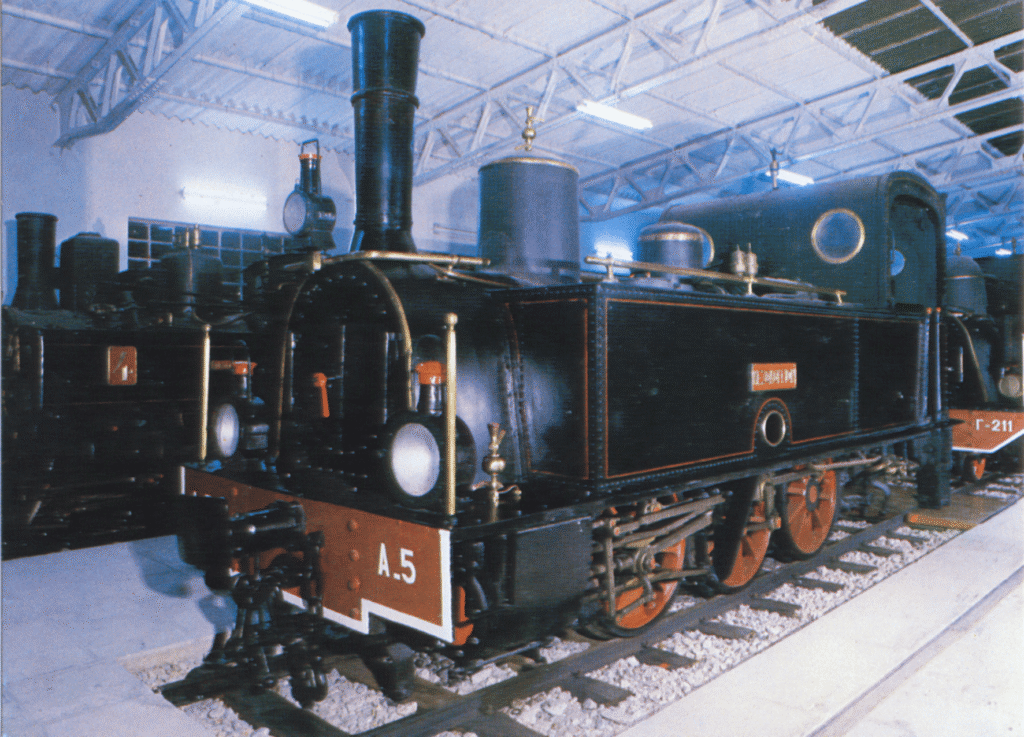
Expansions and the Connection to Local Production
In 1896, a two-kilometer-long spur line was built from Kalyvia to Achelous to facilitate the transport of lumber. The lumber was transported to Patras and used to make crates for packaging raisins destined for export.
This activity reflects the railway’s close connection to the region’s productive and commercial life. At the same time, it highlights the network’s economic vulnerability: the decline in raisin exports reduced its transport volume and brought the company to the brink of bankruptcy.
In 1909, two more branch lines were added, with a total length of approximately eleven kilometers:
- The first one connected the train station to downtown Messolonghi.
- The second line started at the Aitoliko station and, passing through the city, served Neochori and Katochi.
In 1943, Italian occupation forces dismantled the second junction in order to use the materials to build an extension toward Amfilochia. Infrastructure work had begun, but the project was never completed because Italy’s surrender intervened.
The Transition to SPAP and the Maritime Connection with Patras
In 1952, the SBDE company went bankrupt, and operation of the network was transferred to the “Piraeus–Athens–Peloponnese Railways” (SPAP), which were then under state management.
That same year, SPAP launched the “Rhodes” rail ferry. The ship had railroad tracks on its deck and transported railcars between Kryoneri and Patras. Passengers could remain in their railcars during the sea crossing without having to transfer to another vessel.
The compatibility of the two networks—those of Aitoloakarnania and the Peloponnese, which shared the same metric gauge—allowed the rail journey to continue from Patras to Athens.
In 1962, the SPAP was absorbed by the “Greek State Railways” (SEK), which also incorporated the Aitoloakarnania network.
Suspension of Operations
In 1971, during the dictatorship, operations on the line were suspended. This decision deprived the region of an existing railway infrastructure that could have been upgraded and utilized to serve local transportation needs.
Instead of shutting it down, there was an opportunity to consider converting the network into a modern local railway, tailored to the needs of the region’s cities and towns.
Restoration Efforts and the Unfulfilled Reopening
In 1996, an effort began to restore the abandoned line, which continued from 2000 onward. These initiatives were linked to two politicians elected in Aitoloakarnania who served as ministers of transportation: Kokkinovasilis and, subsequently, Verelis.
The work aimed to restore the network as a local railway to facilitate travel between Agrinio, Messolonghi, and the intervening settlements, as well as access to Kryoneri. From there, a connection to Patras via a high-speed passenger ferry was planned.
This prospect could have offered residents an additional transportation option, reduced dependence on road transport, and contributed to improving quality of life and reducing pollution.
Despite the restoration work, the planned reopening did not take place. Following the change in government in 2004, the effort was abandoned, and the infrastructure fell into disuse once again.
For Aitoloakarnania, this development represented a missed opportunity to utilize the railroad for the benefit of residents and local development. The history of the SBDE is not merely about the past of transportation; it also raises the question of how existing infrastructure could serve the needs of a region.