
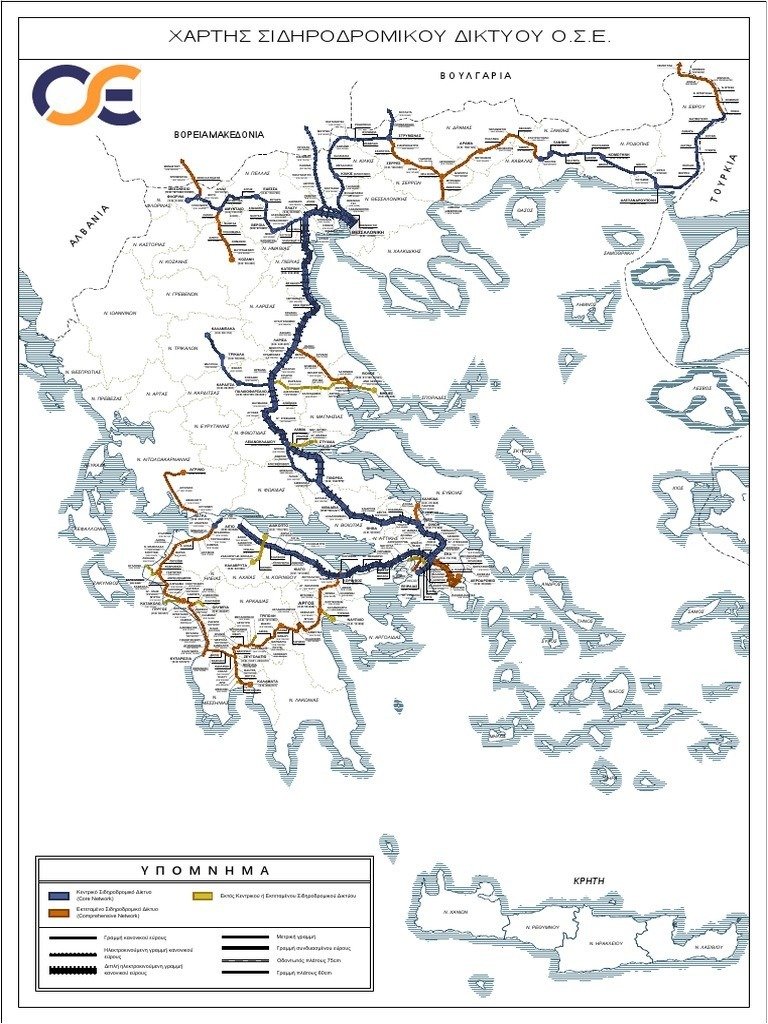


The Greek railway network, which was built to meet the country’s needs at the end of the 19th century, and subject, of course, to the constraints imposed by the financial and other conditions of the time, was not substantially modernized until the mid-1980s, with the exception of repairs to war damage, nor did it shed its linear character, expand into other regions, or take advantage of new technologies and opportunities. In the postwar period, the construction of a modern road network was not given priority funding, and road transport was scandalously subsidized. The railroad, which in 1950 handled approximately 50% of the country’s passenger and freight transport, carried only 6% of passengers and less than 6% of freight by 1990. Meanwhile, KTEL buses accounted for 35% and passenger cars for 57% of land-based passenger traffic. The sharp decline in rail transport in Greece is due to deliberate policy choices made by nearly all postwar governments, which in this way served petty political and clientelistic interests, in accordance with the recommendations of the “American Mission” that was established in Athens to oversee the implementation of the “Marshall Plan” from 1947 onward, which unilaterally and scandalously favored the proliferation of the automobile, without any planning or long-term vision. While any transportation policy should be the result of a thorough study and should aim for a planned and state-controlled allocation of the transportation burden among the various modes of transportation, depending on the broader macroeconomic benefits of each option. The country’s postwar governments, by scandalously promoting road transport, distorted, among other things, healthy competition. This situation has had many negative consequences for the national economy and has led to the decline of entire regions, such as Epirus, as well as a drastic deterioration in citizens’ quality of life and the environment, and an increase in the cost of our exports. It also jeopardizes military transport in the event of the country’s mobilization for war. Furthermore, following the separation of the infrastructure from operations imposed by the European Union, the situation has worsened.
Starting in the mid-1980s, that is, quite belatedly, and only after the negative effects on the economy had become starkly apparent, those in power in Greece began to realize the need to modernize the railways. However, this effort, too, met with limited success, as it proceeded and continues to proceed, at a very slow pace; moreover, it was soon overshadowed by a massive highway construction program, which further cemented the dominance of the automobile. The prolonged failure of capital invested in rail transport to yield returns burdened OSE with interest and principal payments, since the borrowing into which the state had driven it for modernization began to be “serviced” before the investments financed by that borrowing had yielded a return, given that successive governments either obstructed or failed to fund the completion of the overall project, which was necessary for it to become profitable and for the loans taken out to be serviced.
However, in Greece, not only has the railway been neglected, but both its history and its archaeological heritage have been disregarded and left unprotected. The latest example of this negligence was the relocation of the Athens Railway Museum, the only state-run museum in this field, from “Three Bridges” to Lefka in Piraeus in 1919, where, following a grand opening, the exhibits were put into storage, and the museum, which had preserved several remarkable artifacts of industrial archaeology has remained closed ever since. A notable example from its collection is the train’s smoking car, which was donated to Sultan Abdul Mejid by the wife of Napoleon III, Empress Eugénie of France. This is an exhibit that, logically, should be on display at the Thessaloniki Railway Museum.