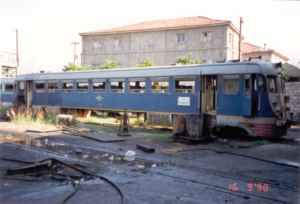
The Annexation of Thessaly and the Need for New Infrastructure
The annexation of Thessaly to the Greek state in 1881 sparked a sense of euphoria among both the Greek people and the political leadership. This was preceded by three years of arduous diplomatic negotiations, following the Congress of Berlin in 1878, to settle the borders with the Ottoman Empire. Despite delays and resistance from the Ottoman government, the process ultimately resulted in the cession of Thessaly and the region of Arta to Greece.
The Greek economy, which had already shown remarkable growth over the previous decade, now gained new opportunities. At the same time, the expansion of the borders raised hopes for the realization of the “Great Idea.”
For the Greek state, the incorporation of the new territories was linked to two objectives: to demonstrate its capacity for modernization and to create the infrastructure that would allow for the exploitation of the region’s productive wealth. In the transportation sector, this meant developing the port of Volos and creating a railway network to serve the Thessalian plain.
As early as September 11, 1881, shortly after the union, the government of Alexandros Koumoundouros signed a contract with the Constantinopolitan banker Theodoros Mavrogordatos for the construction and operation of a railroad line between Volos and Larissa.
From a Single Line to a Regional Network
In 1882, Charilaos Trikoupis became prime minister; he disagreed with the terms of the original contract. He believed that the contract granted the contractor the easiest and most profitable section of the network, without obligating him to build the remaining lines that were necessary for the development of Thessaly.
It therefore proceeded to renegotiate, integrating the project into its broader strategy for the development of the Greek railways.
On May 13, 1882, a new contract was signed between the Greek government and Theodoros Mavrogordatos, who represented the banking firm “Fils A. Mavrogordato.” The contract was ratified by Law AMI/1882 and provided for the construction of a metric-gauge network, that is, with a distance of one meter between the rails. The network would connect Volos with Larissa via Velestino, and Velestino with Kalambaka via Farsala, Karditsa, and Trikala.
On October 25, 1882, Mavrogordatos founded the Greek public limited company “Thessaly Railways,” headquartered in Athens. In addition to his own banking house, the National Bank of Greece, the Privileged Bank of Epirus and Thessaly, and the Industrial Credit Bank. The right to construct and operate the network was transferred to the new company.
The Contribution of Evaristo de Chirico
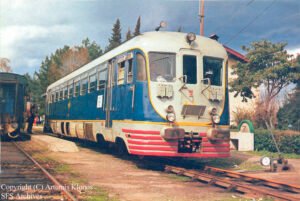
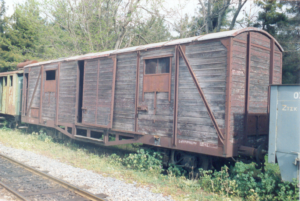
The Italian engineer Evaristo de Chirico made a decisive contribution to the construction and operation of the Thessaly Railways. His work was particularly associated with the Pelion line, as well as with the introduction of new technologies to the network.
His presence in Volos links the city’s railway history with its art history. It was there, in 1888, that his son, the painter Giorgio de Chirico, was born. The images of trains and the railway environment of his childhood left a strong imprint on his work. The small train that appears behind walls in his paintings evokes his memories of Volos and the family home near the train station.
Giorgio studied painting in Athens. After his father’s death in 1905, the family left Greece and settled in Italy.
Evaristo de Chirico was also known for his philhellenic stance. During the Ottoman occupation of Thessaly in 1897, he offered his services to the Greek population of Volos. Drawing on his Italian citizenship, he also helped protect the railway network and secure its release from requisition by the occupying forces.
The Construction of the Thessalian Railway Network
On July 11, 1883, the railroad line reached Larissa. Its opening to traffic, however, was delayed because the necessary facilities at the city’s station had not yet been completed. This was followed, in October of the same year, by severe flooding in the Thessalian plain, which caused serious damage to the line.
Finally, the Volos–Larissa line was officially inaugurated in Volos on April 23, 1884, in the presence of King George I.
The expansion of the network toward western Thessaly proceeded gradually:
- November 13, 1884: The Velestino–Farsala section was opened to traffic.
- June 30, 1885: The railway line reached Sofades.
- October 3, 1885: The extension to Karditsa was completed.
- March 9, 1886: The line was extended to Stefanousai.
- June 16, 1886: The connection to Kalambaka, via Trikala, was completed.
The Pelion Railway Line
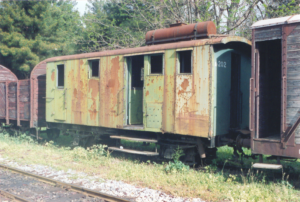
In 1889, the Thessaly Railways decided to build a narrow-gauge railway line (0.60 m) that would connect Volos with Ano Lechonia, Milies, and, in a later phase, Zagora.
The line was intended to serve the transportation needs of residents and visitors, as well as to transport agricultural produce from Pelion. At the same time, the company hoped to boost its revenue, as in some years it barely covered—or fell short of—the network’s operating costs, particularly during the wheat harvest season on the Thessalian plain.
The studies were completed in 1893. That same year, Law BRIB/1893 ratified the contract between the company and the Greek government for the construction of the line to Ano Lechonia. Construction began in March 1894 and was completed in September 1895.
The initial profits from the line’s operation encouraged the company to proceed with its extension to Milies. Despite objections from the government at the time, the relevant contract was signed on September 16, 1900, and ratified by Law BXNTH/1900.
Construction began the following year and was completed in July 1903. The planned extension to Zagora did not take place, as the connection to Milies did not yield the expected financial results.
Inclusion in the S.E.K. and Network Upgrades
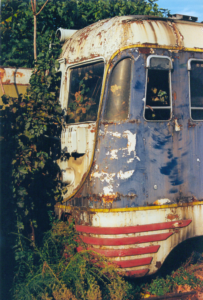
In 1955, the company “Thessaly Railways,” unable to continue operating the network and meet its loan obligations, was absorbed by the “Greek State Railways” (SEK).
In 1960, the Hellenic State Railways (SEK) rebuilt the Volos–Larissa line, converting it from metric gauge to standard gauge (1.435 m). The reconstruction allowed for the operation of heavier rolling stock and the achievement of higher speeds.
In 1997, service was suspended on the Velestino–Kalambaka section to allow for the reconstruction and conversion of the Paleofarsalos–Kalambaka line to standard gauge. The work was gradually completed by January 2001, creating a line capable of handling heavier loads per axle and achieving higher speeds.
Efforts to Preserve the Historic Line
Following the reconstruction of the Paleofarsalos–Kalambaka line, the Velestino–Paleofarsalos section remained metric gauge and was taken out of regular service.
The “Museum Railways Company” (EMOS), founded by the Athens Railway Friends Association together with some of its members, became active on this section. The company was managed by Dimitris Karatolos, a member of the Athens Railway Friends Association.
Through this initiative, our Association sought to operate historic and museum trains, with the aim of preserving Thessaly’s railway tradition, highlighting its history, and boosting tourism development in the region.
However, this effort did not secure the necessary support from local government and the state. The shareholders of EMOS ultimately decided to dissolve the company.